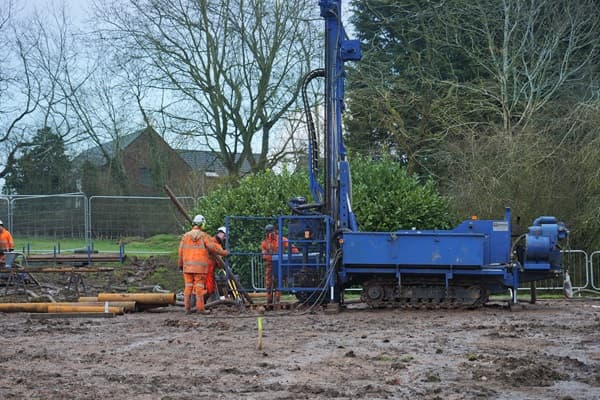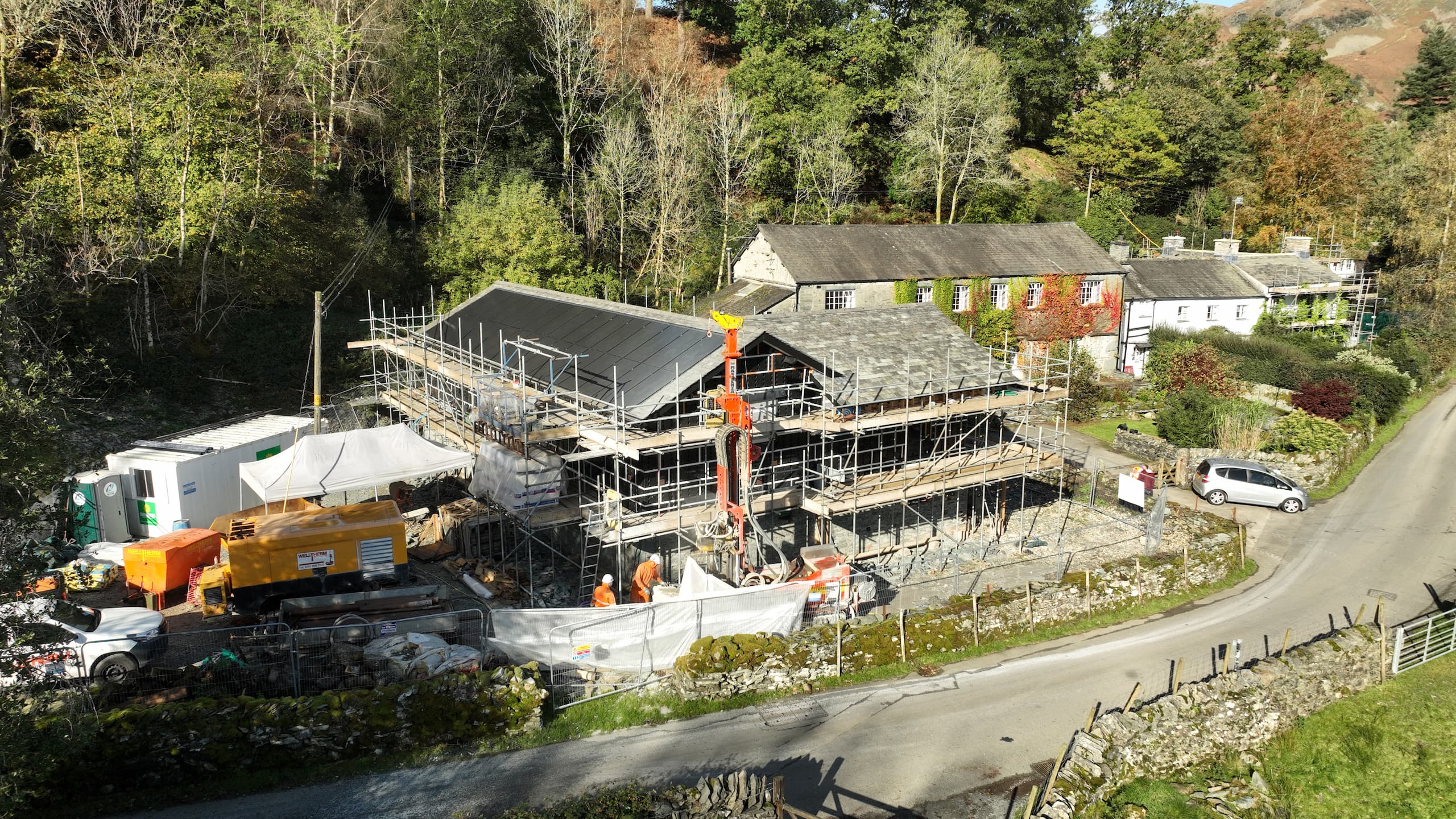
Ground Source Heat Pumps (GSHP) are becoming an increasingly popular option for delivering low-carbon space heating (and cooling) for commercial, public and domestic buildings.
The principle of GSHP technology is long-established and is based on the same process as the common domestic refrigerator.
There are two principal methods for supplying thermal energy in GSHP applications:
Closed loop systems, in which the source loop is long, and is buried in the earth either:
a. as coils of HDPE pipework in ‘cut and fill’ trenches
b. suspended in vertical boreholes
Open loop systems, in which the source loop is covered in pumped groundwater, which is typically re-pumped to the subsurface via another borehole well after passing through the heat pump.
Open Loop Geothermal System
An Open Loop System involves pumping water from an existing source, perhaps a river or a lake, but more often via boreholes that are drilled to access water sources below ground for efficiency.
The water either travels directly to the integral heat pump or more commonly via a plate heat exchanger.
All open loop systems using over 20m³ of groundwater per day are subject to Environmental Agency (EA) regulations.
It must be demonstrated to the EA that the system is not going to affect an existing user of groundwater in the vicinity of the project and that it offers no potential threat to the environment.
Welltherm’s designers, project managers, hydrogeologists, groundwater modellers and supervising engineers work very closely with the EA to ensure that schemes will operate within the EA guidelines and just as importantly will demonstrate the sustainability of the system.
Closed Loop Geothermal System
Closed loop systems utilise a system of plastic pipes which simply circulates the fluid (water and environmentally friendly anti-freeze) through the ground absorbing heat (heating) or rejecting heat (cooling). The heat pump either increases the temperature for heating or decreases it for cooling, dependant on the needs of the building.
This type of system needs to be carefully designed. Borehole depths range from 40m to 200m, and the ‘input’ or ‘output’ capacity of a borehole could vary by a factor of ten, so it’s important that these systems are designed by fully qualified personnel.
A badly designed closed loop system might work for months or years before the system failed, but whilst it is working it will be inefficient and unsustainable.
GET IN TOUCH
Lorem ipsum dolor sit amet, consectetur adipiscing elit. Quisque congue in lacus vulputate.
Lorem ipsum dolor sit amet, consectetur adipiscing elit. Quisque congue in lacus vulputate. Aliquam euismod elit at ex pellentesque, quis facilisis massa vulputate.